
What is Iyengar Yoga
The Iyengar method of Yoga is initially learnt through the in-depth study of asanas (postures) and pranayama (breath control). Mr. Iyengar has systematized over 200 classical yoga Asanas and 14 different types of Pranayamas (with variations of many of them) from the simple to the incredibly difficult. These have been structured and categorized so as to allow a beginner to progress surely and safely from basic postures to the most advanced as they gain flexibility, strength and sensitivity in mind, body and spirit.
Asana
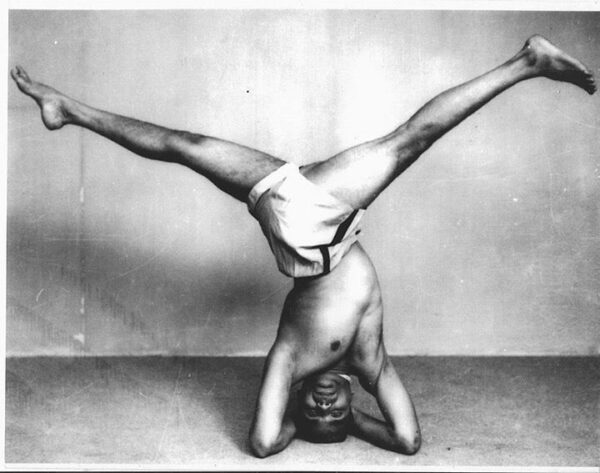 In practice Iyengar yoga focuses particularly on. correct body alignment to allows the body to develop harmoniously in an anatomically correct way so that the student suffers no injury or pain when practising correctly. As all bodies are different and people have different weaknesses and strengths. Mr Iyengar has also developed the use of props to help the body into the correct positions required. Props are objects like wooden blocks, chairs, blankets and belts that help one adjust or support oneself in the different postures so that one can work in a range of motion that is safe and effective.
Other aspects of asana practice in the Iyengar system are correct sequencing in which there is a powerful cumulative effect achieved by practicing asanas in particular sequences. The concept of timings means postures are held for considerable lengths of time to let the effects of the poses penetrate deeper within the individual.
Pranayama
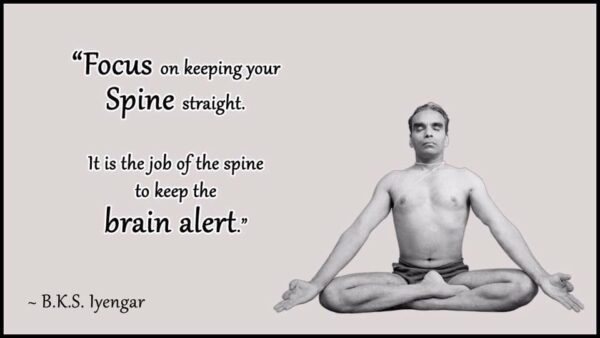 Pranayama is started once a firm foundation in asana has been established as physically the student requires the alignment, flexibility, lung capacity and training necessary to sit and breathe correctly while practicing. Pranayama gives numerous physical benefits including toning the circulatory, digestive, nervous and respiratory systems, activating the internal organs and creating a feeling of energy and calmness. Equally importantly it also brings the mind and senses under control and make the individual fit for the experience of meditation.
Astanga Yoga
 One may, from the above, gain the impression that Iyengar yoga is therefore just gymnastics and deep breathing or only Asana and Pranayama. This is incorrect.
Asanas and Pranayama are merely used as the tools with which to master all 8 aspects of Patanjali’s Astanga yoga. Mastery of the body is the gateway to mastery of the mind. Consider the following: The whole human being from the outermost skin to the innermost being (or soul) is interconnected. For example, if the body is ill, the mind also becomes depressed, lethargic and bad tempered and if the mind is stressed the body becomes tense. The intensity and depth to which Iyengar yoga is practiced on the physical level does affect and change the mind and spirit.
In doing yoga asanas the whole body and mind must learn to become involved. One has to spread one’s awareness to the smallest parts of the body simultaneously, so the mind becomes alert, attentive and sharp. One learns to breathe smoothly deeply and evenly so one’s energy (prana) can flow without obstruction, and one learns to make the mind quiet, passive and receptive thus promoting a meditative state of mind. This makes the body fit for Pranayama.
Pranayama is the essential prerequisite for correct true meditation. Mr Iyengar states that though it is theoretically possible to achieve a meditative state of mind by merely sitting and concentrating, in practice it is not possible for 99% of people. In meditation the mind is absolutely silent but razor sharp. Mr Iyengar says that for normal people, the mind has too many “portals.” It is like a sieve full of water. Whichever hole you block, water continues to pour out of the rest. The mind is too subtle, cunning and restless to be controlled and made still. Therefore, Pranayama is recommended as the breath is used to still the mind. Smooth subtle and controlled breathing is far easier to master the mind and when the breath becomes smooth and steady so does the mind. Then one can learn to withdraw the senses from external objects and cultivate the state of mind where the experience of meditation can come.
Meditation
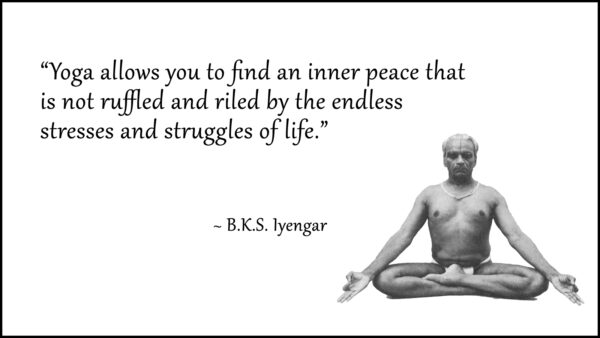 As indicated, meditation is a state of mind that cannot be learnt and thus the practice of sitting and attempting to meditate is not a guarantee of results in itself. Rather the foundations of self-culture have to be built through practicing the first five disciplines of yoga. The experience of meditation comes when the student is ready.
This leads to another keynote of Iyengar yoga: meditation in action. If one can meditate on a flame, grain of rice or other subject, why not meditate on the posture one is performing? So, as a student does yoga postures the mind learns to become aware of the different parts of the body. At first the mind moves from part to part but with training learns to become absorbed in all parts of the body evenly at the same time. One learns to refine one’s awareness and penetrate deeper into the body in order to achieve more accurate and thus effective and comfortable postures. So, the mind is trained to achieve a meditative state of being. Although pranayama is the real key to preparation for meditation, the progress made is applicable to asanas which can be practiced to such a degree of refinement that one meditates in the posture.
WHAT DISTINGUISHES IYENGAR YOGA FROM OTHER STYLES OF YOGA?
Precision And Alignment
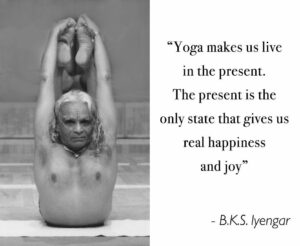 Precision and alignment in the practice of the various asanas forms the hallmark of Iyengar Yoga. If legs are to be straight, then they have to be absolutely straight. If the legs are to be bent at the knees, then they should be right angle between the thigh and the calf. There has to be an alignment between the inner and outer wrist, when the hands are lifted up in Urdhva Hastasana, between the left and right leg in Tadasana and Sirsasana; how the weight has to be equally distributed on the front and back of the foot in Tadasana.
Even the junior-most Iyengar Yoga teacher would start emphasizing precision and alignment in his/her very first Iyengar Yoga class. However, some of the teachers are getting obsessed by “precision and alignment” of the body to the point of ridicule and are forgetting the reason why Guruji insists on precision. The precision is not just for the geometrical presentation of the structure of the body!
The precision in the asana is not merely meant for the alignment of the part, but for the proper functioning of the human being. If the body is aligned with precision, then the breath is aligned with that same precision, if the breath is balanced then the mind, emotions and senses get balanced. We have to study the connections of how these precise adjustments work on the entire human being.
If we are asked to spread and create space between the metatarsals in Tadasana – it is not just to align the inner and outer foot for the sake of the foot. Even a first-time practitioner would realize that extending the foot leads to a firm grip on the quadriceps which come closer to the thigh bone. A firmness in the thighs leads to a sharpness and lift in the gastric and lower abdominal region (which is the Samanic and Apanic region). This in turn elates the thoracic and Pranic region; the breathing automatically becomes deeper and rhythmic with corresponding changes to the senses, mind and emotions. So, the precision and alignment should be accompanied by a study on the effects on the breath and the mind. As a practitioner progresses, he/she needs to learn how the senses, the mind and the breath have to and should be utilized to align the body.
Timing
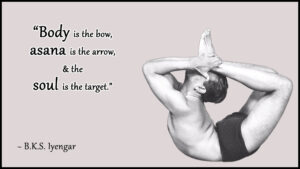 Iyengar Yoga practitioners are known for their “ability” to stay for prolonged duration of time in different asanas. For a beginner, it does mean developing a willpower and is essential in early stages of practice. However, one has to evolve beyond the realms of external force i.e. will. As Guruji has explained in his talk on Citta shakti, one should evolve one’s practices whereby one performs an asana not merely by external force of power of the mind, but the practice should be such that one intrinsically wants to stay in the asana. It is that Atma (citta) which gets to you to perform the asana. Then, naturally sthirata (stability) and sukhata (gladness) come in an asana. One should not be staying in the asanas just because ones’ neighbour is doing so or stay in the pose because the clock demands.
One should stay in the asana as long as one is contemplative, reflective in that asana so that one becomes meditative in whatever asana one is performing. We may extend our chronological duration of staying in the asana, but at the cost of quality. Such a practice has no meaning but is in fact detrimental.
Sage Patanjali also mentions that asanas are mastered when prayatna becomes shaithilya. So, we need to stay in an asana such that the effort required to perform it minimizes. So, we may stay for the same amount of chronological time, but the effort required to maintain it should be diminished.
The performance of an asana includes going into, staying and coming out of the asana. We tend not to give enough emphasis to coming out of the asana. For us, the asana ends with the staying phase. We extend the chronological time to out stay to such an extent that we have no energies left to thoughtfully come out of the asana. It is like utilizing all one’s energies and resources while going up the mountain and having nothing left to come down.
Sequencing
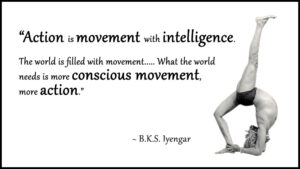 As Iyengar Yoga practitioners, we are aware that it is not just the asana but how you perform them, how long you perform them and also the sequence in which they are performed, which determines the effect of these asanas. The sequence in which the asanas are performed is determined by various factors. These include the purpose of practice, the weather, and time of day, the health status of the practitioner and the level of practice. With over 200 asanas, there can be any number of permutations and combinations. However, there are certain thumb rules. For example, Sarvangasana is never practiced before Sirsasana. Practice generally ends with Savasana or any other such relaxing asanas. Unfortunately, some students and teachers are tending to go overboard with the concept of sequences. They think that sequences are like mantras. One sequence for one disease. One sequence for one individual. It is important to reiterate here that one needs to understand the principles behind sequencing rather than memorizing the sequence alone! Repeating a sequence taught at the Institute will not essentially lead to the same effect.
Props
Props have been a fruit of Guruji’s innovative genius. It is because of the prop that people of all ages and health status can perform asanas with ease and attain benefits of the practice of yoga. As Guruji has explained one should not be using a prop only as a crutch or support but learn from the prop.
Their main purposes are:
- Perform asanas which are difficult to perform independently.
- Achieve and maintain correct alignment during practice.
- Stay longer and relax in challenging asanas in order to attain their full benefits.
- Study and investigate the asana in greater depth.
Hierarchy In Practice
 One of the most important aspects of Iyengar Yoga is hierarchy of practice. A beginner may be taught Trikonasana in his first class while Guruji also practiced Trikonasana after 70 years. Both these are asanas are Trikonasana, but the quality of the asana is totally different. For a beginner, the asana is totally on the skeletal plane, whilst Guruji’s Trikonasana would be in a state of mediation in Trikonasana. A beginner’s Trikonasana would be controlled and guided by teacher while Guruji’s Trikonasana would be guided by his citta.
Thus, as students of Iyengar Yoga, we have to practice asanas and progress in the hierarchy of our practice. We should align our sharira. It is imperative to mention here that sharira which is loosely translated as body in English, in reality encompasses our breath, mind, senses, intellect and emotions. So, although we start with physical alignment, we have to progress to include the complete meaning of sharira.
We should evolve so as to time our practices not only by the clock but to perform them to attain sthirata and sukhata with the practice being progressively being governed by the will, mind, breath, intelligence and finally the citta.
If and only if we understand the principles behind the unique features of Iyengar Yoga, will we be able to progress in the hierarchy in our practice: which is the fifth important aspect of Iyengar Yoga.
So, one can begin to see how Iyengar yoga cultivates all 8 disciplines of yoga and is far from merely “gymnastics and deep breathing.” With practice and understanding, one realises that Asana (posture) is as different from stretching or gymnastics just as Pranayama (Breath control) is different from merely deep breathing and meditation is different from self-induced trance.
The prolonged practice of asana and pranayama affects the individual on an organic (physiological), mental and spiritually level as well as just physically.